


What Does a Track Bar Do on a Jeep?
A Jeep track bar's job is simple: it keeps the axle from moving side to side. That single function is what allows a solid-axle Jeep to feel stable, predictable, and controllable on the road and on the trail.
If the axle shifts even slightly left or right under the Jeep, everything above it feels unsettled. The steering wheel might feel delayed, the Jeep may wander, or it may feel sketchy over bumps.
Understanding what does a track bar do on a Jeep explains why so many “steering problems” are not actually steering problems at all.
What this article covers:
- The Track Bar's Only Job: Stop Side-To-Side Axle Movement
- Why a Track Bar Affects Steering So Much
- What It Feels Like When the Track Bar Isn't Doing Its Job
- Why Track Bar Problems Get Worse After a Lift
- Track Bar vs Sway Bar
- How to Tell if the Track Bar Is the Cause
- How Track Bar Issues Can Lead to Bigger Problems
- When It Makes Sense to Upgrade Your Track Bar
The Track Bar's Only Job: Stop Side-To-Side Axle Movement
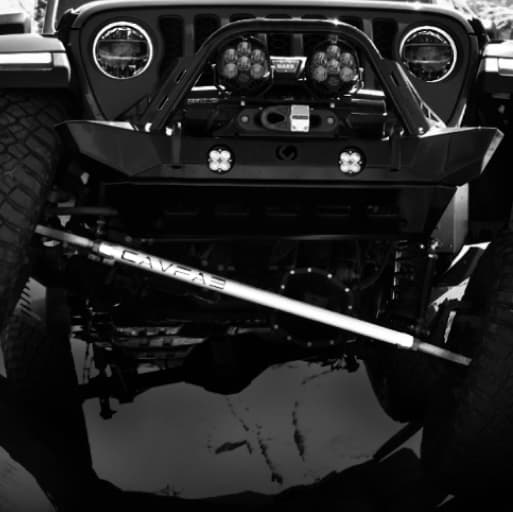
The Jeep track bar exists to center the axle under the Jeep and keep it there. In a solid axle suspension, the axle wants to move laterally whenever the suspension cycles. The track bar is the component that physically prevents that motion.
In plain language, axle centering means the tires stay directly under the frame, rather than shifting left and right as the Jeep moves. When that centering is solid, the Jeep feels planted. When it is not, the Jeep feels vague.
Side-to-side axle movement behind the wheel makes the Jeep feel like it's never quite settled. You correct the steering, then correct again because the axle isn't staying where you expect it to be.
This matters far more on solid-axle Jeeps than on independent-suspension vehicles because the entire axle moves as one unit rather than each wheel moving independently.

Why a Track Bar Affects Steering So Much
A Jeep can feel like it has steering problems even when the steering components are in good shape. That is because steering input only works properly if the axle itself is stable.
When the axle shifts side to side, the tires are no longer staying consistently “under” the Jeep. The steering wheel can turn, but the axle moves before the tires respond the way you expect.
That disconnect creates the sensation of loose or delayed steering.
This shows up most clearly in real-world conditions like bumps, potholes, braking on uneven roads, and small highway corrections. Each of those moments applies a lateral load to the axle. If the track bar allows movement, the Jeep reacts unpredictably.
This is why builders often chase tie rods, ball joints, or even Jeep suspension components when the real issue is axle control, not steering linkage.
What It Feels Like When the Track Bar Isn't Doing Its Job
Track bar issues usually show up in the driver's seat before anything looks obviously broken. Because the track bar's whole job is to keep the axle centered, any looseness lets the axle shift side to side under load, and that “floating axle” feeling shows up in a few repeatable ways.
- Steering delay happens when you turn the wheel, and the Jeep reacts a moment later because the axle shifts laterally first, then the tires finally follow your input.
- Wandering shows up as constant small corrections because the axle is not staying centered, so the tires never feel consistently under the Jeep at speed.
- Clunking or popping over bumps is common when hardware loosens, or mount holes begin to oval, allowing the bar or bracket to shift suddenly under load.
- Intermittent steering shimmy comes and goes because the movement is load- and speed-dependent, meaning certain bumps, speeds, or braking inputs trigger it while others do not.
- A slight “step sideways” feeling happens when the axle shifts left or right as the suspension compresses, so the body feels like it moves sideways instead of tracking straight through the bump.
Our guides on what is a track bar on a Jeep and what is a drag link on a Jeep can help put the whole system in perspective.

Why Track Bar Problems Get Worse After a Lift
Lifting a Jeep changes the geometry of the track bar. The bar now sits at a steeper angle, which increases leverage and stress at both mounting points.
That extra leverage magnifies any looseness that already exists. A small amount of play that felt acceptable at stock height becomes very noticeable once the Jeep is taller and running larger tires.
This is why adjustable track bars exist. Their function is not about tuning or performance flair. They exist to re-center the axle after the suspension geometry changes. When the axle is centered again, steering feel improves immediately.
Ignoring this step after a lift often leads people to misdiagnose issues and replace unrelated parts instead of addressing the root cause.
Track Bar vs Sway Bar
The track bar and sway bar do completely different jobs, and mixing them up sends people down the wrong path.
Both bolt to the axle, both live in the same neighborhood, and both get blamed when a Jeep feels “weird,” but they control totally different kinds of movement. When you diagnose the wrong part, you end up tightening, disconnecting, or replacing things that will never fix the actual problem.
The track bar controls side-to-side axle movement. It's the part that keeps the axle centered under the frame so the tires stay where your steering expects them to be.
The sway bar controls body roll. It's the part that resists the body leaning in corners by linking left and right suspension movement.
- Track bar symptoms usually feel like lateral instability, wandering, or a Jeep that needs constant correction because the axle is shifting under load.
- Sway bar symptoms usually feel like excessive lean, slow “boaty” transitions, or a top-heavy feeling in turns, especially on-road.
If the Jeep feels sketchy over bumps or like it “hunts” at highway speed, start with the track bar. If it leans hard in corners but tracks straight on rough pavement, the sway bar deserves the attention.

How to Tell if the Track Bar Is the Cause
One of the simplest checks requires a helper, and it gives you real answers fast.
Park the Jeep on flat ground, engine running if needed for steering assist, and have someone turn the steering wheel left and right in short, quick inputs. You watch the track bar, both mounting points, and the axle movement.
What you want to see is simple: the track bar should move as a solid link, and the axle should follow without any lag, shift, or knocking.
If you see the axle shifting sideways before the tires respond cleanly, that's not “normal Jeep feel.” That's lost axle control.
- Watch the frame-side mount closely, because bracket flex, loose bolts, or ovaled holes show up here first under repeated load.
- Look for any visible joint movement at the bar ends that isn't the bar rotating normally through its arc. Any snap, jump, or delayed movement is a red flag.
- Listen for a single clunk right as the steering input changes direction, because that often indicates the bar or bracket shifting to the other side of its slop.
- Check for shiny metal or “fretting” marks around bolt heads and brackets, which can indicate parts moving against each other even if everything looks tight at a glance.
- Confirm hardware is actually seated and torqued, because “tight” with a wrench is not the same thing as properly clamped and holding under lateral load.
This diagnostic step is critical before replacing steering components or chasing alignment. A Jeep can have perfect steering parts and still feel awful if the axle is allowed to walk sideways.
How Track Bar Issues Can Lead to Bigger Problems
Track bar looseness is one of the most common contributors to instability on solid axle Jeeps. While death wobble is rarely caused by a single component, track bar play accelerates everything else.
Once the axle can move laterally, every bump feeds energy into the system. That energy gets amplified by tire size, wheel offset, and suspension angle. What starts as a mild shimmy can escalate quickly if left unaddressed.
This is why addressing track bar integrity early saves money and frustration. It stabilizes the foundation before secondary issues develop.

When It Makes Sense to Upgrade Your Track Bar
Certain build changes make track bar upgrades a practical decision rather than an optional one.
- Bigger tires increase lateral load on the axle.
- Harder off-road use adds repeated shock loads.
- Repeated loosening signals mounting or hardware fatigue.
- Bent bars or ovaled mount holes compromise axle control.
- You simply want the steering to feel tight and predictable again.
Upgrading is about restoring function, not chasing parts. The goal is to keep the axle centered so the rest of the system can do its job properly. This becomes even more important when combined with other chassis upgrades like Jeep parts that increase capability and stress.
Conclusion
A track bar prevents side-to-side axle movement, and that stability is what makes a Jeep feel predictable. When the axle stays centered, everything else works the way it's supposed to. Steering feels predictable, bumps stop feeling sketchy, and the Jeep tracks straight instead of fighting you.
That stability starts with understanding how the system works and choosing parts that can actually hold position under load.
If you're tightening up the foundation of your build, start with CavFab-engineered Jeep parts across our Jeep suspension lineup and build axle control that holds up on pavement and on the trail.
Ready to learn more about steering and suspension?