


Jeep JK Steering Components Diagram
If you have ever hunted for a Jeep JK steering components diagram before ordering parts or chasing play in the wheel, you already know why this system matters.
The Wrangler JK steering layout is simple in concept, but every link, joint, and mount affects how stable your Jeep feels on-road and how predictable it stays on rough trails.
This guide walks through the JK steering system from end to end, labels each component, explains what it does, and shows how the parts connect into one working chain
What this article covers:
- Jeep JK Steering System Overview
- Jeep JK Steering Components Diagram (Explained)
- Jeep JK Steering Components (Breakdown by Part)
- How the Components Connect
- Frequently Asked Questions
Jeep JK Steering System Overview
The JK steering system takes driver input at the wheel and turns it into controlled movement at the front tires.
The core idea is a mechanical push-pull linkage controlled by a power steering gearbox, with the track bar keeping the axle centered so the Jeep does not wander.
High-level flow looks like this: steering wheel → steering column and intermediate shaft → steering gearbox → pitman arm → drag link → steering knuckles → wheels, while the tie rod keeps both knuckles synchronized, and the track bar stabilizes axle position.
If you're troubleshooting play or planning upgrades, it helps to know what axles are in my Jeep JK, because tie rod size, knuckle design, and track bar forces change with axle type.

Jeep JK Steering Components Diagram (Explained)
Below is a breakdown of the steering components you would see in a typical JK front end, ordered from the driver to the tires:
- Steering wheel: Your input point, delivering rotation into the column.
- Steering column: Houses the shaft and supports wheel angle and safety functions.
- Intermediate shaft: Connects column output to the steering gearbox with a splined joint.
- Steering gearbox: Converts rotational input into a powerful lateral push-pull motion.
- Pitman arm: Bolts to the gearbox sector shaft, turning gearbox motion into linkage travel.
- Drag link: Runs from the pitman arm to the passenger-side steering knuckle, steering the axle.
- Tie rod: Connects both steering knuckles so they turn together and hold toe alignment.
- Track bar: Laterally stabilizes the front axle and must stay parallel to the drag link for clean geometry.
- Steering knuckles: Pivot points that carry wheel hubs and accept drag link and tie rod loads.
- Ball joints: The upper and lower joints that allow knuckle rotation while supporting vertical load.
- Steering stabilizer: Dampens vibration and reduces shimmy through a small hydraulic shock.
Jeep JK Steering Components (Breakdown by Part)
Let's break down each Jeep JK steering component part by part.
Steering Wheel and Steering Column
The wheel and column are the control side of the system. Issues here usually show up as binding, clunking, or loose tilt play, not death wobble. If the wheel feels vague but the linkage is tight, check column bearings and the lower column coupling.

Intermediate Steering Shaft
This shaft transfers motion out of the cabin and into the gearbox. Worn splines or joints can add a noticeable dead spot at the wheel. If you feel clunking right as you change direction, the intermediate shaft is a common suspect.
Steering Gearbox (Steering Box)
The gearbox is the muscle. It multiplies your input through hydraulic assist and moves the pitman arm. Leakage, sector shaft play, or mounting flex can cause wandering and inconsistent return-to-center. Reinforced mounting and correct torque help the box live longer on larger tires.
Pitman Arm
The pitman arm is the gearbox's lever. It swings left and right with sector shaft rotation, pushing the drag link. A bent or loose pitman arm changes steering response instantly, so check nut torque and spline engagement if the Jeep suddenly pulls or feels off-center.
Drag Link
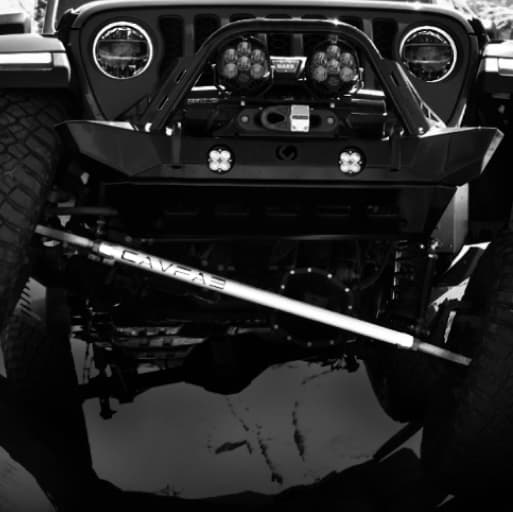
The drag link controls the actual steering direction. When it wears, you get a delay between wheel input and tire response. CavFab's 1 Ton HD Drag Link - BOLT ON - Jeep JK replaces the factory link with solid 1.5-inch 1045 alloy steel and 1 Ton greaseable tie rod ends to reduce play under larger tire load.
Tie Rod
The tie rod keeps both tires tracking together. Any bend or joint slop shows up as wandering and uneven toe changes on bumps. CavFab's 1 Ton Bolt-On Steering System for JK/JKU and its standalone 1 Ton HD Tie Rod - BOLT ON - Jeep JK are built from solid 1045 steel with greaseable 1 Ton ends for higher rigidity than stock.

Track Bar
The track bar prevents the axle from shifting side-to-side under the Jeep. If the bar or its brackets loosen, the axle can oscillate, which is a major driver of death wobble. Geometry also matters; the track bar and drag link should stay as parallel as possible to avoid bump steer.
Steering Knuckles
Knuckles are the pivot hubs of the system. They take the drag link force and transmit it into wheel turn. Bent knuckles are rare, but worn attachment points or loose tapers can create persistent play even after you replace the linkage.
Ball Joints
Ball joints hold the knuckle while allowing it to rotate. Once they wear, steering feels loose, and tires can wobble under load. Big tires accelerate wear, so checking ball joints should be part of any steering inspection.
Steering Stabilizer
A stabilizer does not fix worn parts, but it can reduce shimmy from tire imbalance or trail chatter. If you need multiple stabilizers to mask wobble, the real issue is almost always in joints, track bar mounts, or toe settings.
How the Components Connect
Here is the steering motion chain in the order it happens:
- Steering wheel → column → intermediate shaft: driver input moves through the cabin linkage.
- Intermediate shaft → steering gearbox: rotation enters the box and gets amplified.
- Gearbox → pitman arm: the sector shaft swings the pitman arm laterally.
- Pitman arm → drag link: pitman movement pushes or pulls the drag link.
- Drag link → passenger knuckle: that force turns the passenger-side knuckle.
- Tie rod → connects both knuckles: tie rod pulls the driver knuckle in sync.
- Track bar → stabilizes axle laterally: keeps the axle centered so steering stays predictable.
- Stabilizer → dampens vibrations: reduces feedback without changing geometry.

Frequently Asked Questions
What Causes Play In The JK Steering?
Loose tie rod ends, drag link ends, worn ball joints, or track bar bolt slop are the usual sources. Start by checking every joint for movement while a helper turns the wheel.
How Do I Identify Worn Steering Components?
Look for visible joint movement, torn boots, leaking grease, or linkage that shifts before the tires respond. Any clunk at a direction change usually points to a joint or track bar mount.
Do Bigger Tires Require Steering Upgrades?
Often, yes. Larger tires add leverage and stress to the factory linkage. Upgrading the tie rod and drag link to a 1-ton system helps maintain alignment and reduces joint deflection.
How Often Should Steering Components Be Inspected?
At minimum, inspect at every oil change if you wheel regularly. After hard trail trips, recheck track bar bolts and linkage ends for looseness.
Conclusion
Knowing each JK steering component and how it fits into the chain makes troubleshooting faster and upgrades smarter.
If you feel wandering, shimmy, or delayed steering, start at the tie rod, drag link, track bar mounts, and ball joints, because that is where most JK issues live.
When you are ready to upgrade, our Jeep suspension collection gives you solid solutions built for bigger tires and real trail loads.
For broader Jeep build planning, the CavFab Jeep parts hub is a good starting point for matching systems across your rig.
Ready to learn more? Check out these articles: