

Jeep Gladiator vs. the Competition: How It Stacks Up
Put the Jeep Gladiator against the competition, and it has a few things no other midsize pickup does. You can take the roof and doors off, fold the windshield down, and drive on solid axles front and rear.
No other midsize pickup is rated to tow more, either, at up to 7,700 lb. You’ll find some of the same trail hardware on the Ford Ranger and Chevrolet Colorado, but if your weekends end on a trail, the Gladiator is still the truck to start with.
How the Gladiator’s Specs Compare With Other Midsize Pickups
Only the Gladiator has a solid front axle and a roof you can take off, and it ties the Colorado for the highest tow rating.
| Truck | Max Towing | Most Powerful Engine | Solid Front Axle | Locking Differentials | Removable Roof and Doors |
|---|---|---|---|---|---|
| 2026 Jeep Gladiator | 7,700 lb | 3.6L V6, 285 horsepower (all trims) | Yes | Front and rear (Rubicon) | Yes |
| 2026 Ford Ranger | 7,500 lb | 3.0L twin-turbo V6, 405 horsepower (Raptor) | No | Front and rear (Raptor) | No |
| 2026 Chevrolet Colorado | 7,700 lb | 2.7L turbo four, 310 horsepower | No | Front and rear (ZR2) | No |
| 2026 Toyota Tacoma | 6,500 lb | 2.4L turbo four hybrid, 326 horsepower | No | Rear (available) | No |
| 2026 Nissan Frontier | 7,150 lb | 3.8L V6, 310 horsepower | No | Rear (PRO-4X) | No |
| 2026 Honda Ridgeline | 5,000 lb | 3.5L V6, 280 horsepower | No | None | No |
How Each Rival Compares With the Gladiator
Each of these trucks brings something different to the table, and the Ford Ranger and Chevrolet Colorado come closest to the Gladiator on the trail.
Ford Ranger
The Ranger Raptor (Ford’s high-speed off-road trim) is the most powerful truck here, with a 405-hp (horsepower) twin-turbo V6, and its FOX shocks adjust themselves electronically over rough ground at speed. It also has front and rear locking differentials, which make both wheels on each axle turn together so a lifted tire can’t spin uselessly.
On slow, rocky trails, though, you’ll get more grip in a Gladiator Rubicon. When one front wheel climbs a rock, the Gladiator’s solid front axle presses the opposite tire into the ground, while the Ranger’s front wheels move on their own. Every Gladiator also has tow hooks (strong loops you attach a recovery strap to) front and rear, where only the Raptor has rear hooks.

Chevrolet Colorado
Every Colorado has a 2.7-liter turbocharged four-cylinder making 310 hp and 430 lb-ft (pound-feet) of torque. Torque is the twisting force that gets a truck moving, and the Colorado has more of it than the Gladiator’s 260 lb-ft. It’s also rated to tow up to 7,700 lb, the same as the Gladiator. On the ZR2 (Chevrolet’s off-road trim), you get front and rear lockers and Multimatic DSSV dampers (high-performance shock absorbers).
On a Gladiator, you also get solid axles at both ends, a roof and doors that come off, and tow hooks front and rear on every trim. You can’t get the first two on any Colorado, and its recovery hooks come only on the off-road trims.
Toyota Tacoma
The Tacoma’s i-FORCE MAX hybrid makes up to 326 hp, and every Tacoma comes with underbody protection and front recovery hooks. On its off-road trims, you get a stabilizer disconnect, which frees the front suspension to move further over rocks, and you can add a locking rear differential.
In a Gladiator Rubicon, you can lock both axles instead of just the rear, so the truck keeps pulling when a front wheel lifts too. You also get rear tow hooks on every Gladiator, while on a Tacoma you only get them on the TRD Pro and Trailhunter (its two most off-road-focused trims). The Gladiator is also rated to tow 1,200 lb more, at 7,700 lb against 6,500.

Honda Ridgeline
The Honda Ridgeline has a unit-body, which means that its body and frame are one piece, plus always-on all-wheel drive and a lockable trunk under the bed floor. It has no solid front axle and no low range (a set of extra-low gears for slow climbs), so you’ll want a Gladiator once a trail turns rocky.
Nissan Frontier
The Nissan Frontier’s 3.8-liter V6 makes 310 hp, 25 more than the Gladiator’s, and on its PRO-4X (Nissan’s off-road trim), you get skid plates (steel plates that protect the parts under the truck) and a rear locker. With no solid front axle or front locker, though, you’ll get further on rocky trails in a Gladiator Rubicon, where you can lock both axles.

Features Only the Gladiator Has
The Gladiator has a few features that you won't find on another midsize pickup, and each one changes what you can do on a trail:
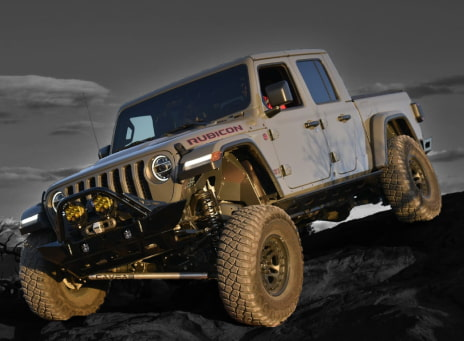
- Open-air driving: You can take the doors off, lift off the available three-piece hardtop, and fold the windshield down. On a warm day, you’ll have nothing between you and the trail, and with the doors off, you can lean out to see exactly where your front tire sits on a rock. In any other midsize pickup, you’re watching the trail through glass.
- Solid axles front and rear: A solid axle is one rigid beam linking the left and right wheels. When one wheel rises over a rock, the beam tips and plants the opposite tire on the ground, so you keep both tires gripping instead of one hanging in the air. On the Rubicon and Mojave, Jeep fits heavy-duty Dana 44 axles with extra-thick tubes and forgings, so they stay strong and rigid when you hit rocks.
- The lowest crawling gears in the class: On the Rubicon, you get a 4:1 low range, which no other midsize pickup has. It brings the crawl ratio (how slowly the truck can creep in its lowest gear) to up to 77:1, so you can ease up a steep ledge slowly and under control instead of building up speed to get over it.
- Tow hooks front and rear on every truck: Every Gladiator has two forged tow hooks up front and one at the rear, whatever the trim. If you get stuck, a friend can pull you out from whichever end is clear, and when you’re the one doing the pulling, you have a strong point to hook a strap to.
Upgrading a Gladiator for the Trail
Every CavFab part is made in the USA. Our customers usually upgrade their Gladiator JT parts in stages, often in roughly this order:
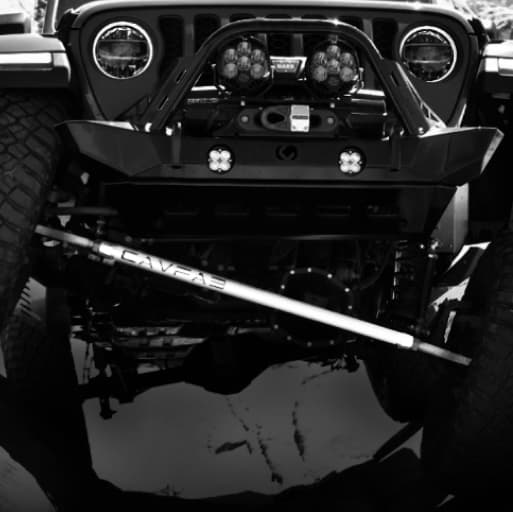
- Steering: Bigger tires push harder on the steering every time a wheel hits a rock, so you’ll want heavy-duty steering parts that stay straight where factory ones can bend.
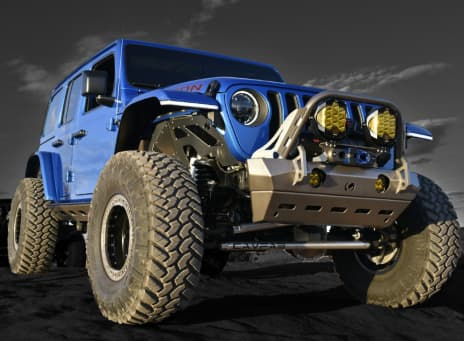
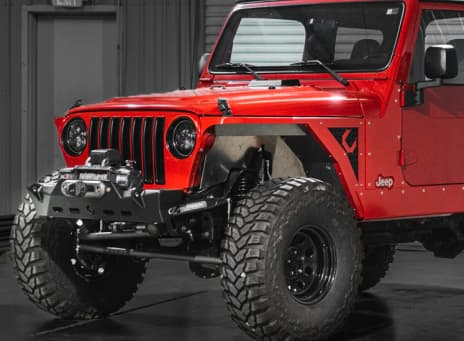
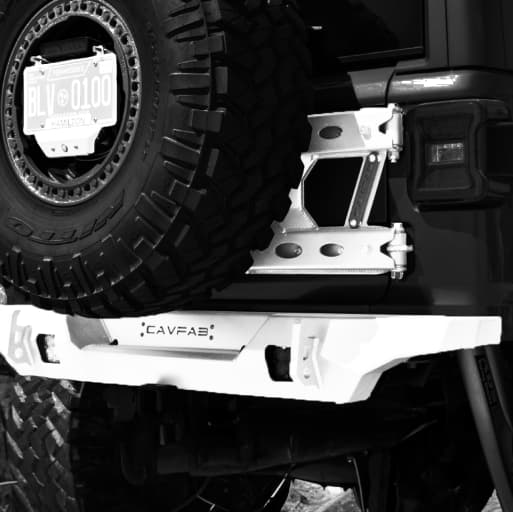
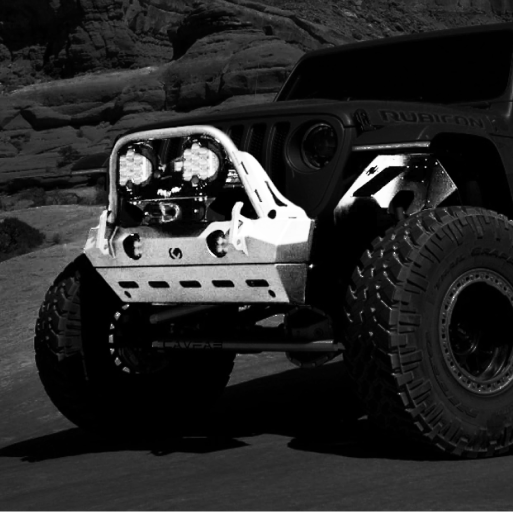
- Bumpers: A steel Gladiator bumper takes the hits on climbs and drops, and you can mount a winch (a motorized cable drum for pulling the truck free) on it.
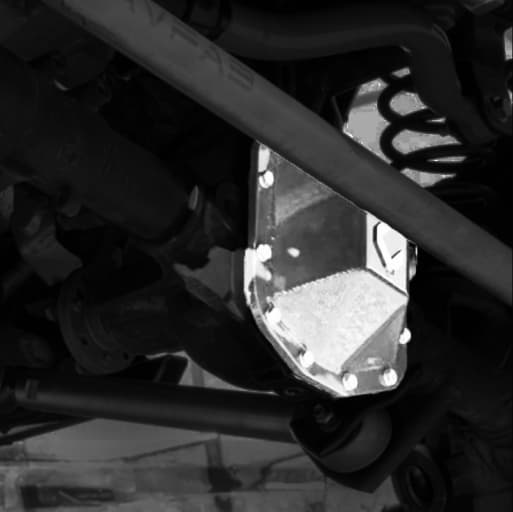
- Armor: Front skid plates and rocker guards cover the underside of the front end and the sides below the doors, so rocks hit steel instead of the body.
- Suspension: A lift raises the truck to fit bigger tires and add ground clearance, and it changes how the truck rides and steers, so plan it alongside your steering.
Because the Gladiator already has solid axles and a low range, you’re adding each of these upgrades to hardware its rivals don’t have at all.
Frequently asked questions
Do you need a Rubicon to take a Gladiator off-road?
Every Gladiator has four-wheel drive, a low range, and solid axles front and rear. On the Rubicon, you also get front and rear lockers, a lower 4:1 low range, and a front sway-bar disconnect, which frees the front wheels to move up and down more on rocks.
Do all midsize pickups come with four-wheel drive?
No. The Ranger, Colorado, Tacoma, and Frontier are all sold with two-wheel drive too, and the Ridgeline uses all-wheel drive with no low range. Every Gladiator is a 4x4 with a low range.
Will Wrangler parts fit a Gladiator?
Many front-end parts will. Our Crawler Series, Rampage Series, and Predator Series front bumpers, our front skid plates, and our 2.5 Ton steering kit all list both the Jeep Wrangler JL and the Gladiator JT. Rear parts are different, so check the fitment list on each product page.
What’s the difference between a locker and traction control?
Traction control brakes a wheel that’s spinning, which sends power across the axle to the wheel that has grip. A locker ties both wheels on an axle together, so they turn at the same speed even when one is in the air. On loose rock, a locker keeps both wheels pulling without relying on the brakes, and the Rubicon has lockers at both ends for exactly that reason.