


Ford Bronco vs Jeep Wrangler
The Ford Bronco vs Jeep Wrangler debate shows up in every trailhead and late-night garage session. Both rigs bring serious off-road credibility, but the way they get there could not be more different.
One leans into modern engineering and comfort. The other sticks to proven mechanical simplicity that has survived decades of abuse. If you plan to keep it stock, the choice looks different from if you plan to cut and upgrade.
Before we get into trail performance, let's look at how the Bronco and Wrangler compare on paper.
What this article covers:
- Quick Comparison: Bronco vs Wrangler Specs
- Off-Road Capability
- Suspension and Ride Quality
- Strength and Durability
- Aftermarket Support and Customization
Quick Comparison: Bronco vs Wrangler Specs
Here is how the Ford Bronco and the Jeep Wrangler platforms stack up on paper.
|
Spec |
Ford Bronco |
Jeep Wrangler |
|
Engine Options |
2.3L EcoBoost I-4, available 2.7L EcoBoost V6, and 3.0L EcoBoost V6 on Bronco Raptor |
2.0L turbo I-4, 3.6L Pentastar V6, 4xe plug-in hybrid, and 6.4L V8 on select 392 models |
|
Axles |
Independent front suspension with a solid rear axle |
Solid front and rear axles |
|
Suspension Type |
Independent front suspension with multi-link rear suspension |
Solid axle suspension with coil springs |
|
Ground Clearance |
Up to 13.1 inches, depending on trim and package |
Up to about 12.9 inches, depending on trim and tire package |
|
Starting Price |
Similar entry pricing, with off-road packages and upper trims increasing cost quickly |
Similar entry pricing, with Rubicon, 4xe, and 392 models increasing cost quickly |
Specs vary by model year, trim, tire package, and factory options, so this table compares the current full-size Ford Bronco and Jeep Wrangler platforms in general rather than one exact trim-to-trim matchup.
Off-Road Capability
Off-road performance comes down to how each platform manages traction and control when the terrain stops cooperating. Both platforms are extremely capable, but they are built for different styles of off-road driving.
Ford Bronco
The Bronco uses independent front suspension, which changes how it behaves once the terrain gets uneven. That design choice shows up immediately in how it handles speed and steering precision.
- Independent front suspension allows each wheel to move separately, which improves stability at higher speeds over rough terrain.
- The platform performs exceptionally well in desert-style conditions, washboard roads, and loose terrain where maintaining momentum matters.
- Steering remains more predictable under load because the front wheels are not mechanically tied together.
- Front differential mounting and CV axle design limit how much articulation the front end can achieve compared to a solid axle.

Jeep Wrangler
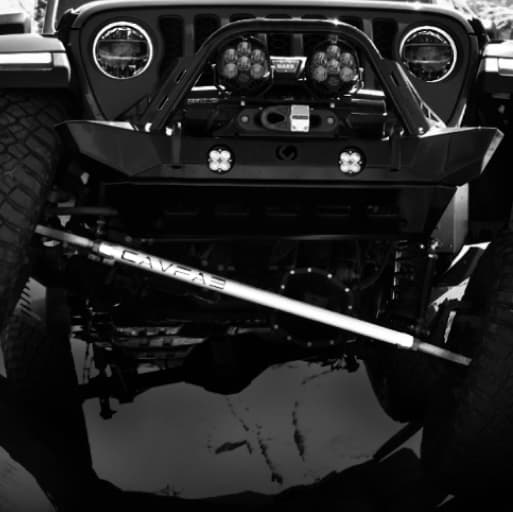
The Wrangler sticks with a solid front axle, and that decision defines its off-road identity. It is not the most refined solution, but it is extremely effective when the terrain gets technical.
- A solid axle keeps both front wheels connected, allowing significantly greater articulation in slow, uneven terrain.
- Tire contact stays more consistent when crawling, especially on rocks, ledges, and off-camber obstacles.
- The design handles repeated compression and impact loads without relying on multiple joints and CV components.
Verdict
Wrangler wins for technical trails
If your idea of a good day involves slow climbs, ledges, and picking lines instead of carrying speed, the solid axle still has the advantage. The Bronco closes the gap more than older IFS platforms ever did, but articulation and simplicity still matter when traction gets unpredictable.
Suspension and Ride Quality
Ride quality tells you what you will tolerate on the drive to the trail, not just once you're on it. This is where the two platforms feel the most different.
Ford Bronco
The Bronco clearly prioritizes daily drivability without giving up off-road performance entirely.
- Independent front suspension absorbs small and mid-size road imperfections more effectively than a solid axle.
- The front end tracks straighter under braking and at highway speeds, especially over uneven pavement.
- Body roll and steering corrections feel more controlled in normal driving conditions.

Jeep Wrangler
The Wrangler makes fewer compromises for comfort, and you feel it immediately.
- The solid front axle transmits more feedback through the chassis, especially over expansion joints and uneven pavement.
- Steering input feels more mechanical, with noticeable play compared to IFS systems.
- Suspension tuning favors travel and durability rather than isolating the cabin from road conditions.
- Larger tires and lift kits amplify ride stiffness if geometry is not corrected properly.
Verdict
Bronco wins for comfort
The Bronco is easier to live with as a daily driver, especially if you spend more time on pavement than on the trail. The Wrangler demands more from the driver but gives that capability back once the terrain gets rough.
Many Wrangler owners accept the firmer ride in exchange for strength, then fine-tune performance with upgraded Jeep suspension systems. Dialing in geometry with properly engineered Jeep control arms also makes a noticeable difference once you start modifying.
Strength and Durability
Durability shows up when you stop thinking about features and start thinking about what breaks under load. This is where design philosophy matters just as much as the specs.
Ford Bronco
The Bronco's front-end design spreads load across multiple components, which works well within its intended use range.
- Independent suspension relies on CV axles, ball joints, and control arms, which introduce more wear points under repeated stress.
- High-speed impacts are handled well, but repeated low-speed articulation under load can accelerate component fatigue.
- Front differential placement and half-shaft design limit how much abuse the system can take compared to a solid axle.

Jeep Wrangler
The Wrangler is built around a simpler, heavier-duty architecture that has been proven over decades.
- Solid axles handle direct impacts and torsional loads without distributing stress across multiple joints.
- The design supports larger tires, heavier accessories, and additional weight without requiring a complete system redesign.
- Fewer moving parts in the front axle reduce the likelihood of failure under extreme use.
- The platform tolerates incremental upgrades without exposing weak points immediately.
Verdict
The Jeep Wrangler wins for durability.
Both platforms are well-engineered, but the Wrangler's simplicity gives it an edge when builds get heavier and terrain gets harsher. There are fewer parts to fail and more margin for abuse.
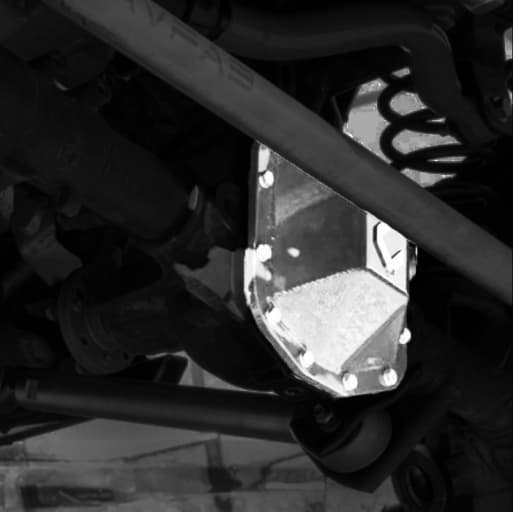
Under harder trail use, factory protection and drivetrain components can become vulnerable. That's why we always recommend reinforced Jeep skid plates and Jeep armor if you're serious about trail use.
Aftermarket Support and Customization
This is where the gap between the two platforms becomes obvious, especially once you move beyond bolt-on upgrades and start planning a long-term build.
Ford Bronco
The Bronco aftermarket has grown quickly since its reintroduction, and support is improving every year.
- Major manufacturers now offer lift kits, bumpers, and armor, especially for common trims.
- The platform benefits from modern CAD-based design, so new products tend to fit well out of the box.
- Fewer long-term durability data points exist for extreme builds compared to older platforms.
- Custom fabrication is often required sooner when pushing into larger tires or more aggressive setups.

Jeep Wrangler
The Wrangler has one of the deepest aftermarket ecosystems in the off-road world, built over decades of continuous development.
- Every generation from TJ to JL and JT has extensive support across suspension, armor, drivetrain, and steering.
- Builders can scale from basic upgrades to fully fabricated systems without running into dead ends.
- Replacement parts, upgrades, and specialty components are available at nearly every price point.
- Platform consistency allows parts knowledge and build strategies to carry over between generations.
- Community experience reduces guesswork, especially when solving geometry or clearance issues.
Verdict
In our experience, the Jeep Wrangler wins by a wide margin
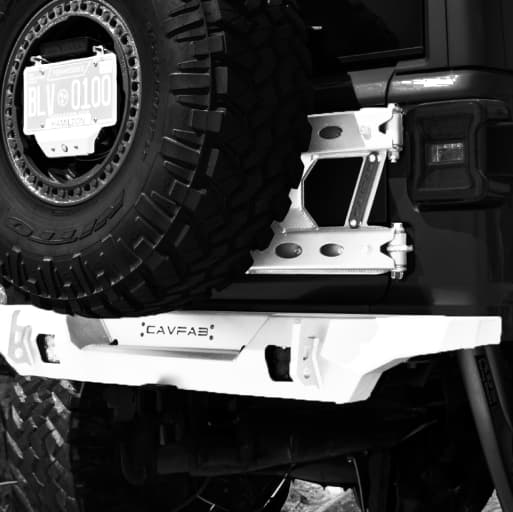
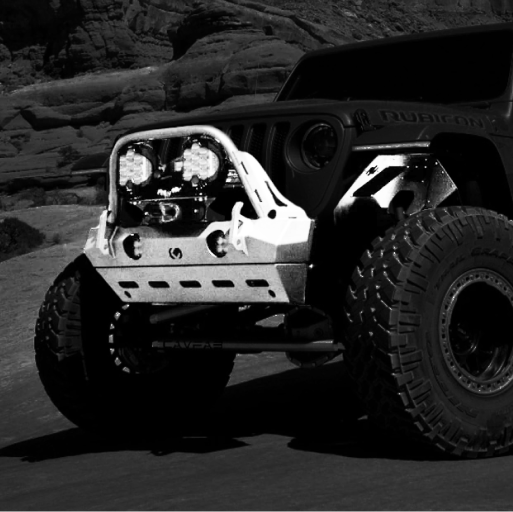
The Wrangler's biggest advantage is its aftermarket depth. Owners can build everything from mild trail rigs to fully armored setups using Wrangler-specific Jeep Wrangler parts, then dial in clearance, protection, and ride quality with Jeep Wrangler fenders, Jeep Wrangler suspension, and Jeep Wrangler bumpers.
That depth gives builders a clear path from stock-ish weekend rig to trail-proven Wrangler without guessing what fits.
Conclusion
For drivers who plan to build and upgrade over time, the Wrangler stands out as the more proven platform, with stronger aftermarket support and more options for improving performance and durability.
Even when comparisons expand into conversations like that of the Ford Bronco Sport vs Jeep Wrangler, the same pattern shows up. The Wrangler gives builders more room to grow when the trail gets tighter, heavier, and harder on parts.
At CavFab, we build for Jeep owners who expect their rigs to take real abuse, not just look ready in a parking lot. Our parts are engineered and manufactured in-house, with components made in the USA from premium steel and tested around real trail use.
Whether you are dialing in Jeep Wrangler suspension, adding trail-ready Jeep Wrangler bumpers, improving clearance with Jeep Wrangler fenders, or planning your next round of Jeep Wrangler Parts, we make components built for strength and long-term trail abuse!