


Best Jeep TJ Upgrades for Strength & Off-Road Performance
Best Jeep TJ Upgrades
The Jeep TJ remains one of the best off-road platforms ever built. It’s lightweight, simple, coil-sprung from the factory, and built around solid axles front and rear. That combination makes it predictable, durable, and extremely capable when upgraded correctly.
What makes the TJ special is not just its aftermarket support. It’s the fact that small, well-chosen upgrades produce noticeable performance improvements.
But that only happens when you build in the right order.
The best Jeep TJ upgrades increase usable capability. Not height for appearance. Not oversized tires without support. Real capability comes from steering strength, corrected geometry, proper gearing, and a clearance that works with suspension travel rather than fighting it.
Foundational Jeep TJ Upgrades
Let’s start where every good TJ build should begin.
Refresh Worn Components First
Most Jeep TJs are over 15 years old. Many are approaching 20+. Before adding lift height or tire size, restore the platform.
Worn components mask themselves as “normal Jeep behavior.” Loose steering, wandering at highway speeds, vague braking feedback, and vibration are often just aging parts.
Start here:
-
Ball joints with play
-
Control arm bushings
-
Track bar bushings
-
Steering linkage wear
-
Radiator and cooling system refresh
A tight front end transforms how a TJ drives. Steering becomes predictable. Alignment holds. Suspension responds consistently.
This is the smartest first upgrade because it ensures every modification that follows works as intended.

Suspension Upgrades
Suspension height determines tire capacity, driveline stress, steering geometry, and articulation potential. Choosing the correct lift height is not just about how tall the Jeep looks. It’s about matching the build goal.
2–3 Inch Lift Kits (Best for 33s)
For most owners, a 2–3 inch lift paired with 33-inch tires is the sweet spot. Here’s why.
At this height:
-
Driveline angles remain manageable
-
A Slip Yoke Eliminator (SYE) is often unnecessary
-
Factory control arm geometry remains usable
-
Caster correction is minimal
-
Ride quality remains comfortable
A properly tuned Jeep Wrangler suspension system at this height maintains stability while unlocking additional ground clearance and articulation.
This setup preserves a low center of gravity, which matters more than many realize. Raising a TJ excessively increases rollover risk and reduces off-camber confidence.
For daily drivers who see trails on weekends, this configuration is difficult to beat.
4 Inch Lift Kits (For 35s)
Once you move to 35-inch tires, a 4-inch lift is common. This is where mechanical nuance becomes critical.
At 4 inches of lift:
-
The factory slip yoke is vulnerable to driveline vibration
-
Pinion angle becomes incorrect
-
Caster decreases
-
Axle centering shifts laterally
-
Brake lines approach their limits
This is where a Slip Yoke Eliminator (SYE) and CV driveshaft become necessary. The SYE shortens the transfer case output and allows a double-cardan driveshaft to correct steep driveline angles.
Without this correction, vibration develops under acceleration and deceleration. Over time, that vibration accelerates U-joint and transfer case wear.
Adjustable Control Arms
Factory control arms are fixed length. When you lift a TJ, the axle rotates backward slightly, reducing caster.
Reduced caster causes:
-
Wandering at highway speeds
-
Poor return-to-center
-
Loose steering feel
Ideal street caster for a TJ is roughly 5–7 degrees. Adjustable Jeep control arms allow you to restore that angle. They also allow you to:
-
Tune pinion angle for driveline alignment
-
Slightly extend the wheelbase for improved stability
-
Fine-tune axle positioning
Without adjustability, taller lifts compromise handling.

Track Bar Upgrades
When lifting a TJ, the track bar arc changes. Because the track bar controls lateral axle positioning, lifting shifts the axle toward the driver's side. Upgraded Jeep track bars recenters the axle and reduces flex under load.
Paired with robust Jeep suspension components, steering precision improves significantly. This becomes especially important as tire size increases.
Tire and Wheel Upgrades
Tire size is often the most visible upgrade, but it has the largest mechanical ripple effect. Increasing tire diameter changes leverage. Leverage changes the load. Load changes failure points.
33-Inch Tires
33-inch tires are the most common TJ upgrade because they deliver real performance gains without overwhelming factory components.
Benefits include:
-
Increased ground clearance at the axle
-
Improved traction footprint
-
Minimal drivetrain stress compared to larger sizes
Many TJs can run 33s without re-gearing, depending on the factory gear ratio. However, performance improves noticeably with 4.56 gears. For most builds, 33s are the most balanced option.
35-Inch Tires
35-inch tires dramatically increase leverage on:
-
Steering linkage
-
Ball joints
-
Unit bearings
-
Axle shafts
-
Ring and pinion gears
Larger tires require re-gearing to restore torque multiplication. A TJ with factory 3.73 gears and 35-inch tires feels sluggish because the effective gear ratio drops.
For 35s:
-
4.88 gears are common
-
5.13 gears benefit automatic transmissions or heavier builds
Re-gearing restores throttle response, improves crawl control, and reduces drivetrain strain.
Tire size must be matched with steering strength and axle reinforcement. Otherwise, you simply move the weak point elsewhere.

Proper Wheel Backspacing
Wheel backspacing determines how the tire sits relative to suspension components. Too much backspacing (wheel too far inward):
-
Causes rubbing on the control arms
-
Limits steering angle
Too little backspacing (wheel too far outward):
-
Increases scrub radius
-
Adds leverage to steering components
-
Accelerates ball joint wear
Proper backspacing improves articulation and reduces unnecessary stress. Wheel choice is not cosmetic. It directly affects steering load.
Steering Upgrades
Factory TJ steering linkage was never designed for modern 33- or 35-inch tires. As tire size increases, steering leverage increases exponentially.
A larger tire acts like a longer pry bar. When the tire contacts an obstacle, force transfers directly into the tie rod and drag link. If steering fails, the vehicle does not move.
Heavy-Duty Tie Rod and Drag Link
Upgrading the tie rod and drag link before moving to larger tires is one of the smartest decisions a TJ owner can make.
Factory linkage bends easily under trail impact. Once bent, toe alignment changes, steering becomes unpredictable, and component wear accelerates.
A reinforced steering system increases:
-
Resistance to bending
-
Steering precision
-
Confidence under load
Strengthening steering before adding lockers or larger tires prevents cascading failures.
Steering Geometry and Caster
Steering feel is not just about strength. It’s about alignment. When the lift height increases, the caster decreases. Lower caster reduces straight-line stability.
Restoring caster angle with adjustable control arms improves:
-
Return-to-center
-
Highway stability
-
Steering predictability
Geometry correction is just as important as strength.
Track Bar Reinforcement
The track bar and drag link operate in arcs. If their angles do not match, bump steer develops. Bump steer occurs when the suspension cycles and the steering wheel moves unintentionally.
Reinforcing and properly aligning these components significantly improves steering precision, especially with larger tires.

Drivetrain and Axle Upgrades
In our experience, increasing tire size and traction without addressing the drivetrain is where many TJ builds go wrong. Torque multiplication, axle strength, and driveline angle must match the level of traction you’re adding.
Re-Gearing
Increasing tire diameter reduces the effective gear ratio. For example:
A TJ with factory 3.73 gears and 31-inch tires may feel responsive. Move to 33-inch tires, and the same 3.73 ratio effectively behaves more like 3.50. Move to 35s, and it drops even further.
The result:
-
Slower throttle response
-
Increased clutch wear (manual transmission)
-
More transmission heat (automatic)
-
Reduced crawl control
Re-gearing restores torque multiplication.
For 33-inch tires:
-
4.56 gears are typically ideal
-
4.10 gears are workable but softer
For 35-inch tires:
-
4.88 gears are common
-
5.13 gears benefit heavier builds or automatic transmissions
Manual transmissions often tolerate slightly taller gearing. Automatics benefit from deeper ratios to compensate for torque converter characteristics.
Lockers
Lockers dramatically increase traction by forcing both wheels on an axle to rotate together.
Rear lockers are typically installed first because they provide major traction gains without significantly affecting steering. Front lockers add serious climbing capability but increase steering effort under load.
Selectable lockers allow control. Automatic lockers are simpler and stronger but less refined on pavement.
However, lockers increase stress on:
-
Axle shafts
-
U-joints
-
Ring and pinion gears
-
Differential housings
Before adding traction, ensure your axle strength matches the demand.
Axle Reinforcement
The Dana 35 rear axle is the weakest and most common factory TJ axle. With 33-inch tires and conservative driving, it can survive. With 35s and a locker, shaft failure becomes much more likely.
Chromoly axle shafts significantly increase tensile strength and resistance to twisting.
Even the Dana 44 benefits from upgrades when running 35-inch tires aggressively. Larger tires amplify torque loads at low range.
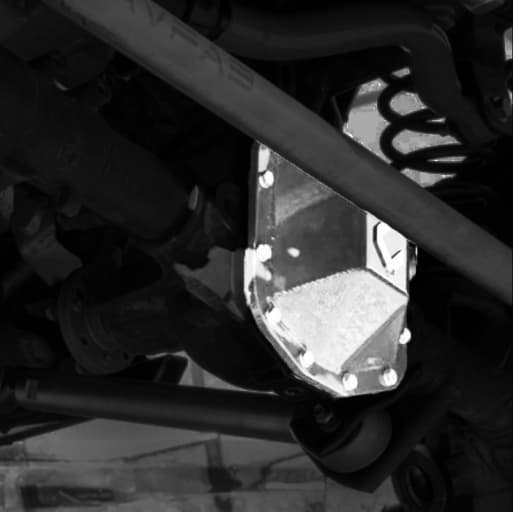
Upgrading protection around the housing with reinforced covers and structural Jeep differential components helps prevent housing deflection and gear misalignment after hard impacts.

SYE Kit and CV Driveshaft
At approximately 4 inches of lift, the driveline angle becomes steep enough that vibration is common.
A Slip Yoke Eliminator (SYE):
-
Shortens the transfer case output
-
Allows installation of a double-cardan CV driveshaft
-
Corrects rear driveline angle
Without an SYE, vibration during acceleration is common. That vibration leads to premature U-joint wear and transfer case stress. For 4-inch lifts, this upgrade is not optional if long-term reliability matters.
Armor and Protection Upgrades
As capability increases, so does exposure to impact. The TJ’s short wheelbase helps breakover angle, but obstacles still contact underbody components. Protection is not cosmetic. It preserves mechanical alignment.
Skid Plates
The factory TJ transfer case skid doubles as a crossmember, but it is thin and prone to denting.
Common impact zones include:
-
Oil pan during steep descents
-
Transfer case on ledges
-
Fuel tank on rear departure
Heavy-duty Jeep skid plates prevent deformation that can damage oil pans, dent fuel tanks, or misalign drivetrain components.
A dented skid may look minor, but misaligned drivetrain components can cause long-term vibration.
Rock Sliders
Rocker panels on a TJ are vulnerable during side contact. Frame-mounted sliders distribute force into the frame rails rather than the body tub. Body-mounted steps bend. Frame-mounted sliders slide.
If your TJ sees technical terrain, sliders are structural necessities, not just accessories.
High-Clearance Fender Flares
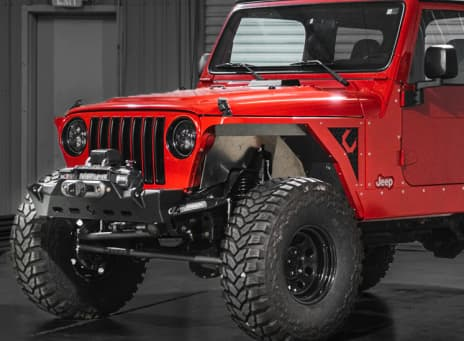
Lift height is not the only way to clear larger tires. High-clearance Jeep TJ fenders raise the wheel opening rather than raising the entire vehicle.
This approach provides:
-
Increased vertical compression room
-
Reduced reliance on oversized bump stops
-
Lower center of gravity compared to the stacking lift height
-
Improved off-camber stability
Front high-clearance options in 0-inch, 2-inch, and 4-inch widths allow you to match coverage to build goals.
Rear bolt-on flares increase coverage and protect quarter panels when articulation pushes tires outward.

Recovery Upgrades
A capable TJ can still leave you stranded if you can’t recover it safely. Recovery upgrades help you control risk when traction disappears, or you have to back out of a bad approach with the Jeep loaded and off-camber.
Front Winch (8,000–10,000 lb Range)
For most Jeep TJs, an 8,000–10,000 lb winch hits the sweet spot. You’re getting enough pulling power to move the vehicle when it’s buried or hung up, but you’re not adding unnecessary weight to the nose.
A smarter recovery setup usually means balancing three things: mounting strength, weight, and usability. Synthetic rope helps reduce front-end weight and is easier to handle on the trail, while a properly designed mounting platform keeps the winch load tied into the Jeep's structure.
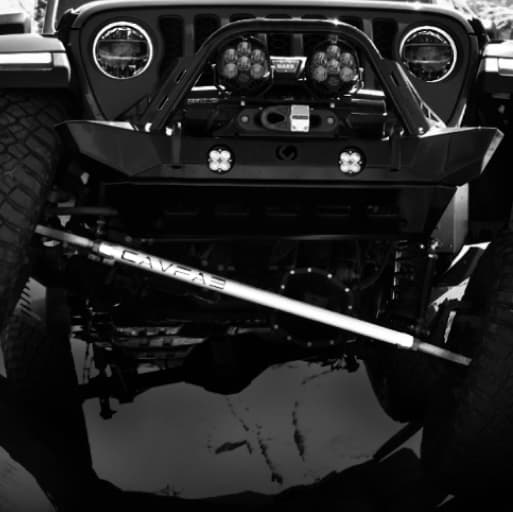
That’s also where a strong front bumper for Jeep Wrangler becomes more than a styling choice. It’s the foundation for safe pulls and repeatable recovery.
Recovery Points
Frame-mounted recovery points distribute load correctly and reduce the chance of hardware failure. They also let you recover in a controlled way, with straighter pulls and better strap alignment.
If you’re upgrading your front end for recovery, treat it as a system: mounting structure, hardware, and connection points should all match the same standard.
Onboard Air
Onboard air lets you air down for grip and ride quality, then air back up before pavement. That’s not just convenience. It helps protect sidewalls, improves contact patch on rocks, and reduces wheel hop when climbing.
On a short-wheelbase TJ, those small traction improvements add up fast because the Jeep transitions weight so quickly.
If your TJ sees regular trail time, onboard air becomes one of those upgrades you use constantly, not just in emergencies.

Best Jeep TJ Upgrades by Build Style
Not every TJ needs 35-inch tires and a 4-inch lift. The best upgrades depend on how the Jeep is actually used. Before adding parts, define the mission.
Here’s how to approach it based on real-world build styles.
Daily Driver with Mild Trails
A 2-inch lift and 33-inch tires maintain drivability while improving trail capability.
Steering reinforcement prevents premature wear from larger tires. Skid plates protect critical components during occasional trail contact. This setup prioritizes reliability and balance.
Weekend Trail Rig
A 3-inch lift paired with 33s or moderate 35s increases articulation and clearance.
At this level:
-
Re-gearing improves throttle response
-
Lockers increase traction
-
Armor becomes critical
-
Steering reinforcement is mandatory
The goal is controlled capability without pushing geometry beyond correction.
Dedicated Rock Crawler
A 4-inch lift and 35-inch tires require a complete system approach.
Necessary components include:
-
SYE and CV driveshaft
-
Adjustable control arms
-
Re-gearing
-
Axle reinforcement
-
High-clearance fenders
-
Reinforced steering
At this level, every system interacts with every other system. Clearance, traction, and strength must scale together.
Conclusion
A TJ doesn’t need to be overbuilt to be capable. It needs the right upgrades in the right order. Steering strength keeps bigger tires from bending parts.
Correct geometry keeps the Jeep stable. Gearing restores torque. Clearance built into the wheel opening keeps lift height under control. Protection keeps small mistakes from turning into expensive damage.
CavFab builds TJ upgrades the same way we approach our engineering: strength first, precision fitment, and American-sourced materials.
When you’re ready to turn plans into a reliable setup, start with Jeep Wrangler TJ parts, dial in with robust Jeep suspension, and handle clearance with Jeep fenders and Jeep inner fenders.
Finish the build with trail-ready protection like Jeep skid plates and Jeep armor so the Jeep can take contact and keep moving.